E-Commerce & Sales
AI Automation for E-Commerce: Stop Losing Sales to Slow Operations
Slow follow-ups, stock errors, and manual order management are quietly killing your e-commerce revenue. Here's how automation fixes all three.
AI Automation for E-Commerce: Stop Losing Sales to Slow Operations
It is 11 PM on a Friday. A customer places a $300 order on your Shopify store. They are excited.
But your inventory count is wrong. The item actually sold out three hours ago. The customer never gets a confirmation email because your integration failed.
You find out at 8 AM on Saturday. Now, you have to write a painful apology email, process a manual refund, and lose a customer forever.
This is the hidden cost of running an e-commerce brand on manual processes.
A Systems Problem, Not a Staffing Problem
When order volume spikes, most store owners try to solve the chaos by hiring more customer support reps. They think they have a staffing problem.
They don't. They have a systems problem.
Hiring a human being to check inventory numbers and send emails is a massive waste of money. Humans get tired. They make typos. They log off at 5 PM.
If your process relies on a human remembering to click a button, that process is broken. It will fail exactly when you are busiest.
We see this exact bottleneck every day. The only scalable solution is to take the human out of the loop for these repetitive, high-volume tasks.
Here are the three specific automations your store needs to stop bleeding revenue.
1. The Real Abandoned Cart Recovery
Almost every e-commerce owner turns on Shopify’s basic abandoned cart email. It waits 24 hours and sends a generic text block.
By the time that email arrives, the customer has already bought the item from Amazon. You are too slow.
The manual version of recovery is nonexistent. You cannot physically watch carts and email people one by one.
The automated version acts instantly. A custom workflow triggers within 10 minutes of cart abandonment.
It sends a personalized SMS directly to their phone. If they don't buy, it sends a highly visual email an hour later. In our experience, speed is the only thing that recovers lost carts.
2. Dynamic Inventory Alerts
Managing stock across multiple channels is a nightmare. Doing it manually means you are always guessing.
The manual version looks like a store owner checking a massive spreadsheet every morning. By the time you notice an item is low, you have already paid for Facebook ads driving traffic to a sold-out product.
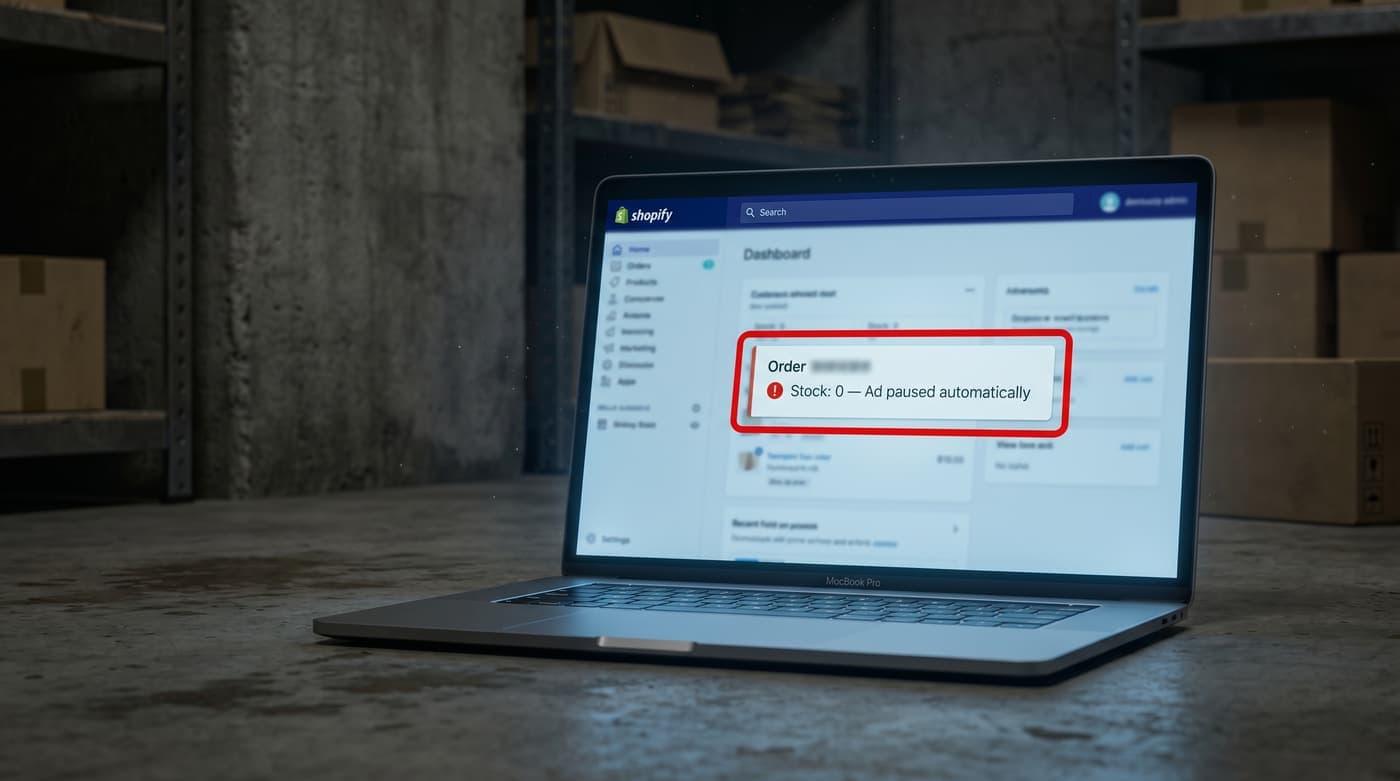
An automated inventory system acts as a guardrail for your ad spend.
When stock drops below a specific threshold, the system automatically sends a notification to your team in Slack.
More importantly, it connects directly to your Meta Ads account. It automatically pauses the campaign for that specific product. You stop paying for clicks you cannot fulfill instantly.
3. Post-Purchase Follow-Up Sequences
The easiest customer to sell to is the one who just bought from you. Yet most brands never speak to them again after sending the shipping code.
The manual version requires your support team to track delivery dates and email customers asking for reviews. It never happens consistently.
The automated version handles the entire lifecycle.
Three days after the tracking API marks the package as "Delivered," the system sends a review request.
If you sell a consumable product like coffee or skincare, the system waits 30 days. Then, it sends a reorder reminder. It even builds an upsell sequence based specifically on what they bought.
This is where true infrastructure matters. We build the automated engines that drive repeat purchases while you sleep, completely hands-free.
The Glass Box Model: Own Your Engine
Most store owners try to build these flows using consumer tools like Zapier.
That works when you have 10 orders a month. But Zapier charges per task. When you scale to 1,000 orders, your monthly software bill explodes. You are punished for growing.
At FabSolutions, we use the "Glass Box" model.
We build these workflows on open-source platforms and host them on a private server. You pay for the initial build, and then you own the system completely.
There are no per-task pricing limits. There are no bloated monthly retainers to an agency.
Your ongoing cost is the raw server fee, which is usually around $50 a month. You own your infrastructure.
Want to see exactly what this looks like? Check out our automation examples to see real workflows in action.
Stop letting slow operations kill your profit margins. If you want to fix these funnel leaks without hiring more staff, bringing in an ai automation agency for e-commerce brands is the fastest way to build systems that scale.
Book a free AI consultation with our team. We will audit your current checkout process and show you exactly what to automate first.